The short answer
Gums are evergreen, so they can be pruned at any time of year, but late winter to spring, before the heat and the fire season, suits most jobs. Cut back to a branch collar or a side branch, as the pruning standard AS 4373 describes, never to stubs. For a native gum, the state rules exempt maintenance pruning of no more than a third of the foliage of each plant, not the trunk; overlays can be stricter. Topping a gum to stubs is lopping, and it grows back as weak, dense shoots.
The best time to prune a gum
There's no single right month for a eucalypt the way there is for a rose or a fruit tree. What matters more is the reason for the job:
- Before summer. Branches over the roof and gutters, and limbs low over the house on a bush-edge block, are best dealt with in late winter or spring, before the Fire Danger Period.
- Deadwood and broken limbs: any time. Dead and hanging branches are what fall first in wind.
- Avoid the hottest, driest weeks. A gum already stressed by drought copes worse with losing leaf, so heavy pruning is better left until it has had some rain.
Deciduous street and garden trees such as elms and oaks are a different story: they're easier to prune bare, in winter. Street trees on the nature strip are council's, and its guidelines say they "are not to be pruned or lopped by property owners"; ask the City of Greater Bendigo on 1300 002 642.
Need this done?
How much can you take off?
For a native gum, Clause 52.17 of the planning scheme exempts lopping or pruning "for maintenance only, provided no more than 1/3 of the foliage of each individual plant is lopped or pruned". The exemption doesn't cover the trunk, and doesn't apply on a roadside. Gums from other states (such as lemon-scented gum and sugar gum) aren't native vegetation under that clause, but the canopy tree rule (Clause 52.37) or an overlay can still protect them. In the residential zones, that rule's maintenance-pruning exemption also needs the tree left at least 5 metres tall with a canopy at least 4 metres across.
Some overlays are stricter. Greater Bendigo's Vegetation Protection Overlay schedule 1 (wildlife corridors) requires a permit to "remove, destroy or lop any native vegetation", for instance. Check your VicPlan report, and see the permit guide for how.
A third is the legal limit for the exemption, not a target. Good pruning usually takes much less: the dead, the broken, and the few branches that are actually causing the problem.
Pruning or lopping?
"Lopping" is what most people search for and what many Bendigo businesses call the work. In practice it usually means cutting branches back to stubs to shorten a tree. A gum answers with a mass of fast shoots from just under each cut. Those shoots are weakly attached, and the stubs can let decay in, which is why lopped gums drop limbs a few years later and need lopping again.
Pruning cuts each branch back to where the tree can seal the wound: the branch collar, or a side branch big enough to take over. The Australian Standard AS 4373-2007, Pruning of amenity trees, describes how. Ask for it by name when you get a quote, and ask exactly which branches will go.
- Crown lifting: removing the lowest branches to clear a roof, driveway or fence
- Crown thinning: taking selected branches out through the canopy to let light and wind through
- Deadwooding: removing dead, dying and broken branches
- Reduction: shortening the crown by cutting back to side branches, not stubs
Roof, possums and powerlines
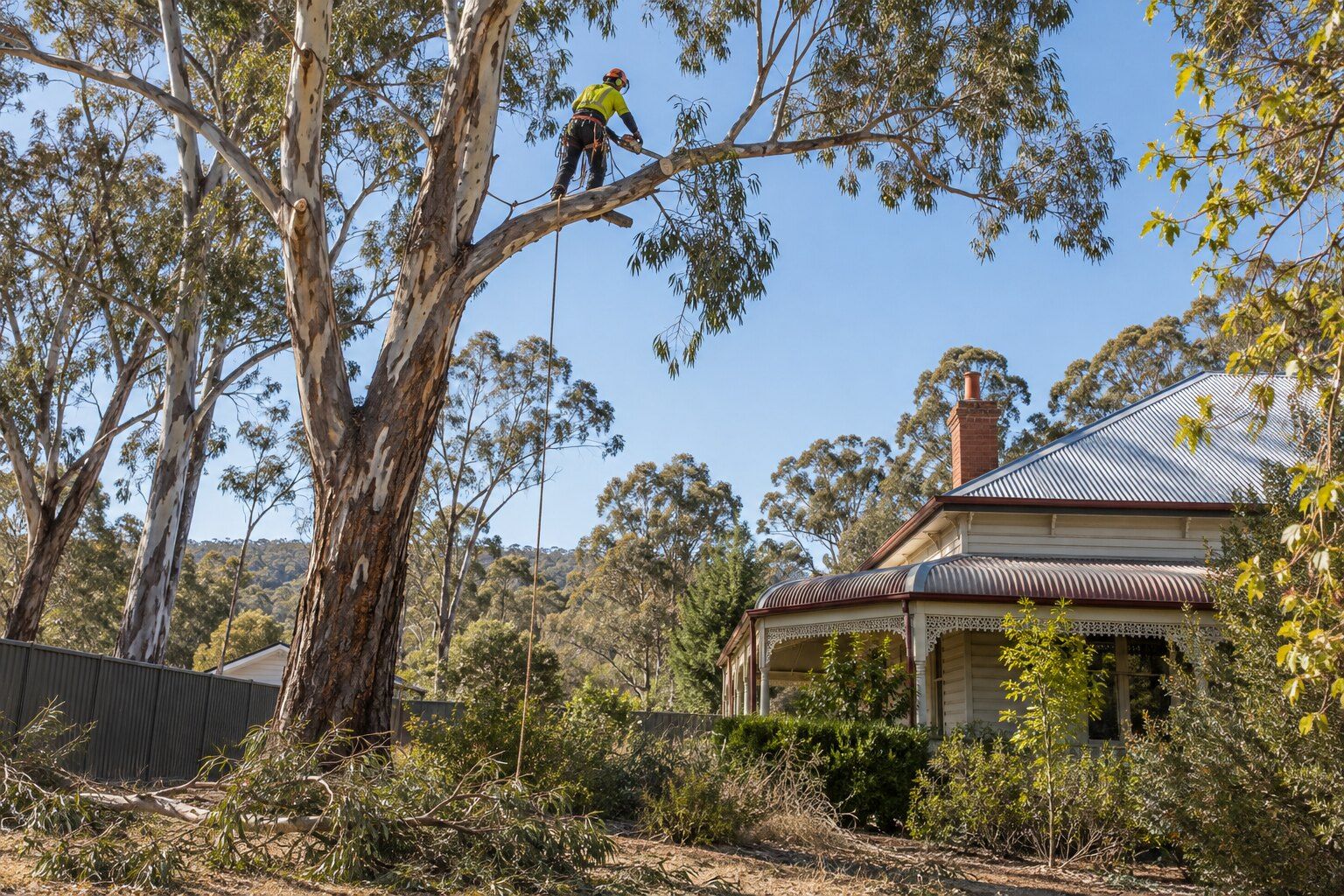
- Roof and gutters. Bushfire planning rules for new homes in the Bushfire Management Overlay say trees "must not overhang or touch any elements of the building". It's a sound target for any house near the bush.
- Possums. The Victorian Government's possum advice is to "prune all branches that lead to the roof, and leave a gap of at least 1.5 meters".
- Powerlines. Only workers authorised by Powercor can work on trees in the No Go Zone around its lines. Energy Safe Victoria says the service line to your house is yours to keep at least one metre clear.
What pruning a gum costs
Pruning is priced per job, after seeing the tree. The only published Australian pruning bands we found are national:
Published national pruning prices
| What's charged | Published price | Who publishes it |
|---|---|---|
| Small tree, up to 10 m | $200 – $500 | Jim's Trees, national |
| Medium tree, 10–20 m | $300 – $800 | Jim's Trees, national |
| Large tree, above 20 m | $500 – $3,000 | Jim's Trees, national |
National Australian pruning estimates published by Jim's Trees, checked 2 October 2026. These are not Bendigo prices or quotes from this website. The page's metadata was updated 19 November 2025; it has no visible update date. The table doesn't state a billing unit, whether GST is included, or which work and waste removal the bands cover. Ask for those details in your written quote. The source's small and medium categories both include 10 m.
Height, how many cuts, whether a climber or an elevated platform is needed, and whether the green waste is chipped and taken away all move the price. The tree pruning cost guide covers each one, and lopping and pruning explains what the work involves.
Questions about pruning gum trees
When is the best time to prune gum trees?
Gums are evergreen and can be pruned at any time of year. Late winter to spring suits most jobs, so branches are off the roof before summer, and dead or broken limbs can come off whenever you see them. Avoid heavy pruning in the hottest, driest weeks.
Can I prune a gum tree without a permit in Bendigo?
Usually, for maintenance. The state native vegetation rules exempt pruning of no more than one-third of a native plant's foliage, not including the trunk and not on a roadside. In the residential zones, the canopy tree rule (Clause 52.37) has the same one-third exemption for a tree at least 5 metres tall with a 4 metre canopy, as long as the pruning leaves it at least that size. Some overlays, such as the Vegetation Protection Overlay, require a permit to lop native vegetation, so check your VicPlan report.
Is lopping bad for gum trees?
Cutting gums back to stubs produces dense, weakly attached regrowth that's prone to breaking, and the stubs can let in decay. Pruning back to a branch collar or side branch, as AS 4373 describes, avoids that.
How far should branches be from the roof?
Bushfire planning rules for new homes in the BMO say trees must not overhang or touch the building. The Victorian Government's possum advice is a gap of at least 1.5 metres between branches and the roof.
Where this information comes from
The rules and figures on this page come from these published pages, checked on 27 September 2026.
- Greater Bendigo Planning Scheme, Clause 52.17 Native vegetation · State-wide native vegetation provision and its table of exemptions
- Greater Bendigo Planning Scheme, Clause 52.37 Canopy trees · State-wide canopy tree provision for residential zones, its definitions and table of exemptions (amended VC315, 24 September 2026); checked 22 October 2026
- Greater Bendigo Planning Scheme, vegetation and heritage overlays (VPO, SLO, ESO, HO) · Overlay clauses and their Greater Bendigo schedules
- Standards Australia: AS 4373-2007 Pruning of amenity trees · The Australian Standard for pruning, store listing
- Greater Bendigo Planning Scheme, Clause 53.02 Bushfire planning · Defendable space vegetation management requirements (Table 4), clause 53.02-5 dated 05/05/2026 VC248
- Victorian Government: brushtail possum wildlife management methods · DEECA guidance on keeping possums off roofs, updated 18 June 2024
- CitiPower and Powercor: vegetation management · The electricity distributor for Bendigo, on trees near powerlines
- Energy Safe Victoria: trees and vegetation · State electrical safety regulator, service lines and fallen powerlines
- City of Greater Bendigo: Nature Strip Guidelines · Council rules for nature strips and street trees
- Jim's Trees: tree pruning cost guide · National tree service, Australian pruning guide; metadata updated 19 November 2025, prices checked 2 October 2026
- VicFlora (Royal Botanic Gardens Victoria) · Flora of Victoria: river red gum, yellow box and grey box native; sugar gum and lemon-scented gum introduced; checked 6 October 2026