The short answer
Roots don't usually break sound pipes; they find their way into cracked or leaking joints and grow inside, catching rubbish until the drain blocks. Call a licensed plumber or drain cleaner to clear and camera the line. In Greater Bendigo, Coliban Water looks after sewer mains and the house connection branch up to 1 metre inside your boundary; pipes beyond that are yours. Wall cracks wider than 5 mm are significant, says Victoria's building regulator, and need an engineer. Removing the tree is only part of the fix.
Roots in sewer and stormwater pipes
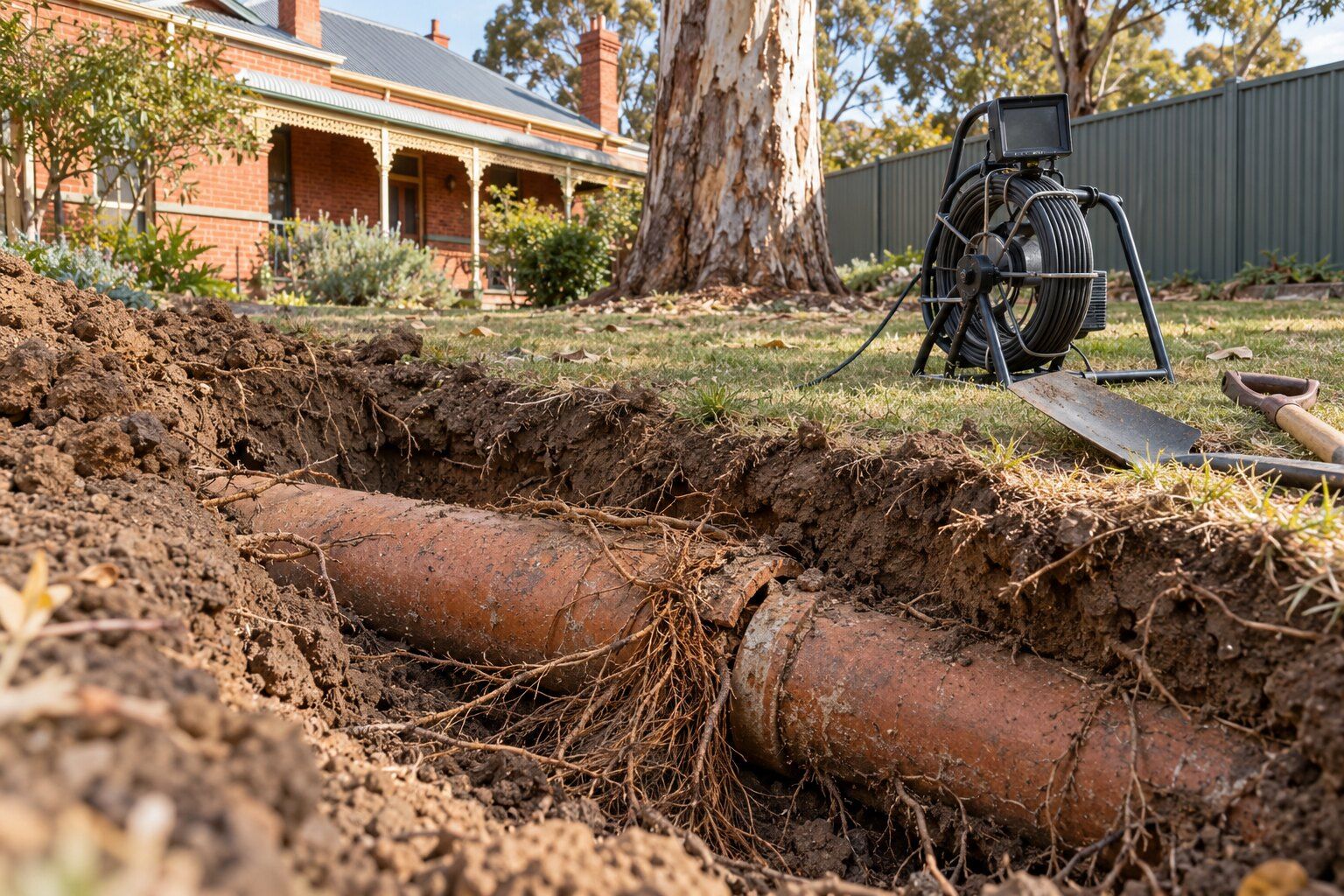
Coliban Water, which runs Bendigo's water and sewerage, says "tree roots can intrude into pipes, catching oils and rubbish", reducing flow and causing costly blockages. Signs of a sewer blockage it lists include:
- Toilets or drains that are slow to empty
- Bubbling or gurgling noises from drains
- Overflow from your plumbing or from the overflow relief gully outside
Older homes, common across central Bendigo, often have earthenware drains with many joints, and big gums or other thirsty trees in the yard. A plumber or drain cleaner can clear the roots and run a camera down the line to find the entry point. Clearing alone is a short-term fix if the joint stays cracked.
Need this done?
Your pipes or Coliban Water's?
Coliban Water says it looks after "sewer mains and house connection branches (HCB) up to 1 metre inside the property boundary". The property owner is responsible for "internal plumbing, septic tanks and pipes within the property boundary".
So roots in the pipe under your back lawn are usually yours to fix. If your plumber finds the problem is in the house connection branch, Coliban says a plumber who isn't on its inducted register must contact Coliban to ask whether it can charge Coliban for the work. If you're not sure where the problem is, Coliban is on 1300 363 200.
Roots and house footings
Clay soils swell when wet and shrink when dry. Building sites are classed by how reactive the soil is, from A (non-reactive) through S, M, H1, H2 and E, with P for soft soil or fill. The Building and Plumbing Commission, Victoria's building regulator, says "the more reactive the soil, the greater the possibility of excessive movement in the footings of the house", and lists "tree roots growing under footings" among the causes of foundation movement. Trees draw a lot of water from the soil, so a big tree close to the house can dry the clay under one side of it.
The commission's guide to cracking:
- Cracks more than 5 mm wide "are considered significant and outside the tolerances for footing movement"
- Cracks between 1 mm and 5 mm should be monitored over a full year
- Bulging walls and doors or windows that stick or distort can be signs too
- For significant movement, the cause "should be further investigated by an endorsed civil or structural engineer"; if the home is under 10 years old, start with the builder
Does removing the tree fix it?
Sometimes, but not on its own. Roots already in a pipe still need clearing and the pipe still needs repairing, and stump grinding removes the stump, not the roots, which rot away over years. Under a house on reactive clay, the commission's advice is to keep the foundation soil from "significant moisture changes". Taking out a large, established tree changes the soil moisture too, so on a cracked house get the engineer's view before the tree comes down, not after.
Removal also has to be allowed. A large tree can need a permit under the state native vegetation rules, the canopy tree rule in residential zones, or an overlay; the permit guide shows how to check. Other options include root barriers, relining the damaged pipe, or pruning the tree to reduce its water demand. When removal is the answer, see the published tree removal prices, and grind the stump if you're replanting nearby (grinding vs removal).
When the roots are from a neighbour's tree
The Victorian Government's guidance says "you have the right to cut back any branches, leaves, or roots that cross your property boundary line at your own cost", but you're liable for damage you cause to your neighbour's tree. Cutting major roots can destabilise a tree, so get advice first.
Where roots have damaged your property, the same guidance says your neighbour may be liable. Check your insurance, then gather evidence, such as an arborist's report, photos and repair quotes, and talk to your neighbour. The neighbour's tree guide covers the next steps, including free mediation.
Planting the next tree
Coliban Water's advice is to find out where your pipes run before planting, plant a safe distance away, check council's nature strip requirements and choose suitable species. The building regulator says to plant new trees "away from the house to allow for root growth".
Questions about tree roots in pipes and foundations
Who pays for tree roots in the sewer pipe?
In Coliban Water's area, it maintains sewer mains and the house connection branch up to 1 metre inside your property boundary. Pipes within the property beyond that are the owner's responsibility. Call Coliban on 1300 363 200 if you're unsure where the blockage is.
Can tree roots crack a house slab?
Roots growing under footings, and trees drying reactive clay, are both causes of foundation movement listed by Victoria's Building and Plumbing Commission. Cracks wider than 5 mm are considered significant and should be investigated by an endorsed civil or structural engineer.
Will removing the tree stop the roots?
It stops new growth, but roots already in a pipe need clearing and the pipe needs repairing. On reactive clay, removing a big tree near the house changes soil moisture, so ask an engineer first if there's already cracking.
Can I cut my neighbour's tree roots?
Victorian Government guidance says you can cut roots that cross your boundary, at your own cost, but you're liable for damage you cause to the tree. If the tree is protected, you may need a permit, so check with council.
Where this information comes from
The rules and figures on this page come from these published pages, checked on 27 September 2026.
- Coliban Water: what can go down the drain · Coliban Water on tree roots in pipes and signs of a sewer blockage
- Coliban Water: who's responsible · Bendigo's water corporation on which sewer pipes are the owner's and which are Coliban's
- Building and Plumbing Commission: minimising foundation movement and damage to your house · Victorian building regulator's guide to reactive soils, tree roots and cracking, modified 11 August 2026
- Victorian Government: trees in Victoria · Dispute Settlement Centre of Victoria guidance on neighbours' trees, updated 26 February 2026
- Greater Bendigo Planning Scheme, Clause 52.17 Native vegetation · State-wide native vegetation provision and its table of exemptions
- City of Greater Bendigo: removal of native vegetation · Council planning information sheet