How to measure a tree's height with your phone
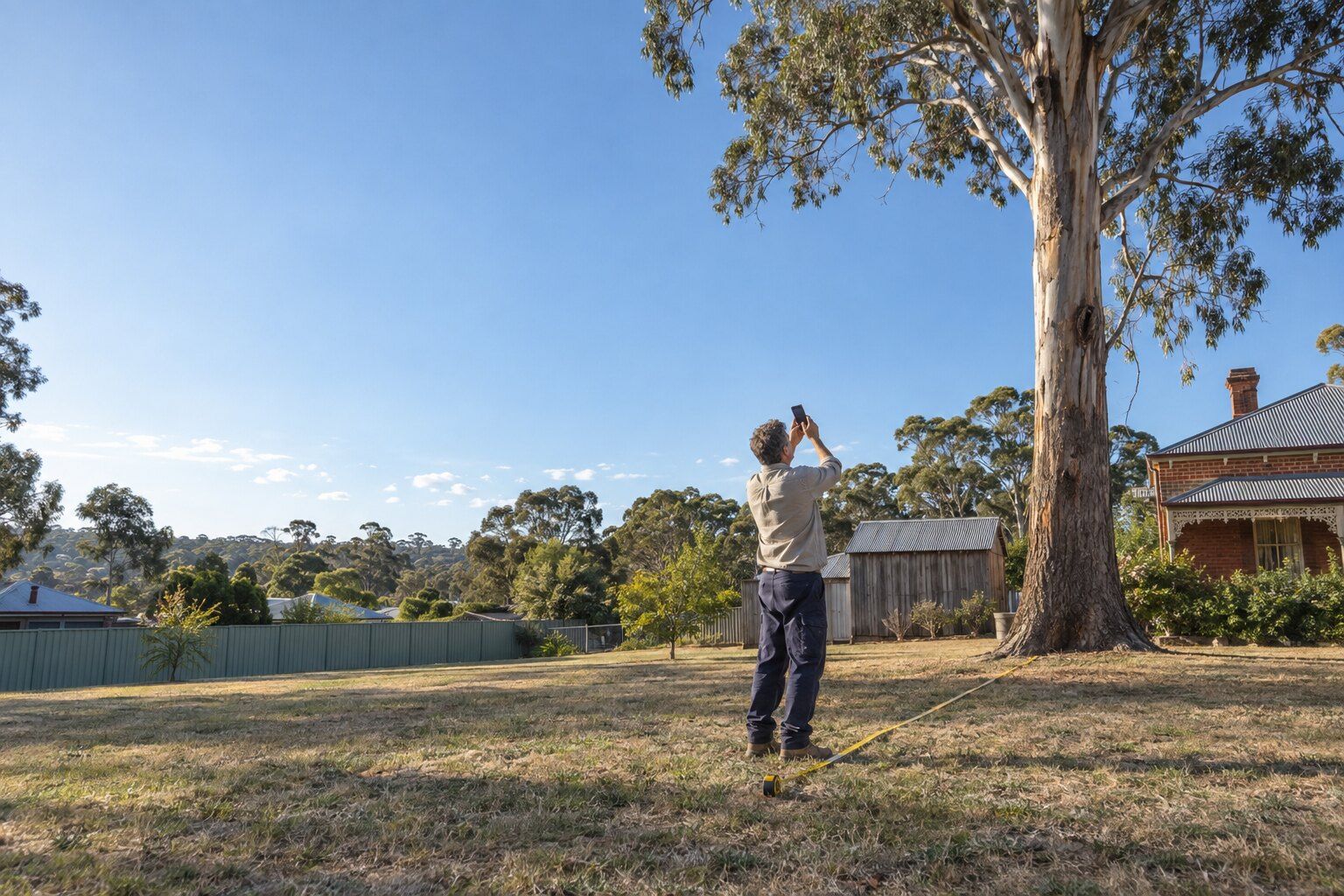
- Stand on level ground where you can see the very top of the tree, ideally about as far from the trunk as the tree looks tall.
- Measure the level distance from where you stand to the trunk.
- Measure your eye height: the ground to your eyes.
- Tap "Use my phone's tilt sensor". On an iPhone, allow motion access when asked.
- Hold the phone at eye level, screen up, and look along its top edge at the top of the tree. Tap "Use this angle" while it's lined up, or type the angle in if you used another clinometer.
The phone measures the angle between level and your line of sight. If the sensor isn't available, the calculator still works with an angle you enter yourself.
The shadow and stick method
No phone sensor needed. On a sunny day, a tree's shadow and a stick's shadow fall at the same slope, so the tree's height is to its shadow as the stick's height is to its shadow. Stand a straight stick upright on level ground near the tree, then measure the stick, its shadow and the tree's shadow, from the trunk to the shadow's tip, within a few minutes of each other. Shadow tips are soft, so the calculator allows 10% either way (our allowance).
How the fall-zone check works
A tree that falls whole from its base can reach as far from the trunk as it is tall. The check compares the distance you enter with the top of the height range, so a measuring error doesn't make a near miss look safe. It reports one of three results:
- Within reach: the house, fence or shed is no further away than the tree could be tall.
- Outside reach, inside two tree lengths: a whole-tree fall shouldn't reach it, but Safe Work Australia describes felling a whole tree as needing at least two tree lengths of open space around the base, and WorkSafe Victoria warns that logs and branches can bounce for considerable distances.
- Beyond two tree lengths: well clear of a whole-tree fall. Falling limbs and storm debris can still travel.
This is a guide to how close a tree is, not an assessment of whether it will fall. Splits, dead limbs, lean, root damage and soil movement all matter, and they're for a qualified arborist to assess.
The maths behind the calculator
The formulas, worked through
Tree height and fall-zone formulas
| Step | Formula | Worked through |
|---|---|---|
| Phone tilt (clinometer) | Height = distance × tan(angle) + eye height | 20 m × tan 40° (0.839) + 1.6 m = 18.4 m |
| Shadow and stick | Height = tree's shadow × stick height ÷ stick's shadow | 18 m × 1 m ÷ 1.2 m = 15 m |
| Fall reach | Could it reach? Distance to the house ≤ top of the height range | House 12 m away, tree up to 16.5 m: within reach |
| Wider zone | 2 × the top of the height range | Tree up to 16.5 m: 33 m |
Our arithmetic. The angle allowance (2° either way) and the shadow allowance (10% either way) are our own. The two-tree-length zone is from Safe Work Australia's guide to managing the risks of tree work (March 2023), checked 6 October 2026.
Common questions about tree height and fall zones
How accurate is measuring a tree with a phone?
It's an estimate. A hand-held reading can easily be a degree or two out, the ground may not be level, and the highest point of a tree is often not directly above its trunk. The calculator shows a range, allowing 2° either way on the angle (our allowance), and checks the fall zone against the top of that range.
Why measure the distance to the trunk, not to the tree's edge?
The formula needs the level distance from your eyes to the point under the top of the tree. For an upright tree that's the trunk. If the top leans out, a US tree-measuring handbook advises finding the spot on the ground directly beneath the top and measuring to that.
If the tree is shorter than the distance to my house, is it safe?
Not necessarily. A falling tree or limb can break up, bounce or slide, and a tree with dead limbs over the roof is a hazard whatever its height. A qualified arborist can assess the tree itself.
Should I cut the tree down myself?
No. Felling and sectional removal are work for trained, equipped tree workers, and anything near power lines must be left to people authorised to work near them. Use the result to describe the tree when you ask for a price.
Does the height change the price of tree removal?
Height is one of the main things removal prices are based on, along with what the tree sits over and the access. See published Bendigo tree removal prices by tree size.
Where this information comes from
The safety guidance on this page come from these published pages, checked on 6 October 2026.
- Safe Work Australia: Guide to managing the risks of tree work (March 2023) · National work health and safety guidance for tree work, March 2023
- WorkSafe Victoria: Working safely with trees · Victorian work health and safety regulator, January 2020
- American Forests: Tree-Measuring Guidelines · United States champion-tree measuring handbook (US source; method only)
- Energy Safe Victoria: trees and vegetation · State electrical safety regulator; reviewed 16 March 2026