The short answer
Check the permits before anything is cut. In Greater Bendigo, removing native vegetation needs a planning permit unless an exemption applies; the main one for house blocks covers land under 0.4 hectares, counting any adjoining land you own. In the residential zones, every tree at least 5 metres tall with a 4-metre canopy on a vacant lot needs a permit too, native or not, and a building permit doesn't change that. Overlays can add more. Inside the Bushfire Management Overlay, clearing for a new house's defendable space is exempt within limits. No Bendigo business we found publishes a block clearing price; tree removal, stump grinding and machine time are priced per job after a look at the block.
Do you need a permit to clear a block in Bendigo?
Three sets of rules apply to trees and scrub on a block, and they're checked separately. Start with a free planning property report from VicPlan, which shows your zone and any overlays.
Native vegetation (Clause 52.17)
"A permit is required to remove, destroy or lop native vegetation, including dead native vegetation", unless the clause's table of exemptions says otherwise. For a house block the key exemption is land that, "together with all contiguous land in one ownership", has "an area of less than 0.4 hectares" (4,000 m²). Own the lot next door too? Add the two together. There's no exemption for clearing to build a house in the residential, Low Density Residential or Rural Living zones, and a building permit doesn't create one. If a permit is granted, the clause requires an offset to compensate for the loss of native vegetation.
Large trees on vacant residential lots (Clause 52.37)
In the General Residential, Neighbourhood Residential, Township, Residential Growth, Mixed Use, and Housing Choice and Transport zones, a tree at least 5 metres tall with an average canopy of at least 4 metres is a canopy tree. On a vacant lot every one needs a permit to remove or lop it, native or exotic. The rule's exemptions have no row for building a house or holding a building permit. A tree assessed as part of a planning permit application for the dwelling is the exception, but most single houses on lots of 300 m² or more don't need a planning permit, so ask council how it applies to yours. A canopy tree application can go through VicSmart. The canopy tree rule section of our permits guide covers measuring and the exemptions. Low Density Residential, Rural Living and Farming zones aren't covered by this rule.
Overlays
A Vegetation Protection Overlay needs a permit for the vegetation its schedule lists, and it has no small-block exemption. Environmental Significance and Significant Landscape overlays can also protect vegetation, and the Heritage Overlay does where its schedule turns tree controls on. Your VicPlan report lists any that apply.
Planted trees, regrowth less than 10 years old on lawfully cleared land, and slashing native grass for maintenance each have their own exemptions under the native vegetation rules, with conditions. If you're relying on one, check the wording in our permits guide or ask council's duty planner on 1300 002 642 before anyone cuts.
Need this done?
Clearing for a new house in the Bushfire Management Overlay
Many bush blocks around Bendigo are in the Bushfire Management Overlay (BMO), and a new house there usually needs a planning permit. The planning scheme also has a specific exemption (Clause 52.12-5): clearing "to enable the construction of a dwelling" and "create its defendable space" doesn't need a separate vegetation permit, if the land is in the BMO and a listed zone, and the clearing stays within the distance set by the bushfire attack level a building surveyor decides, or a BMO permit condition.
Greater Bendigo's two BMO schedules ask a single dwelling for defendable space "for a distance of 30 metres around the dwelling or to the property boundary, whichever is the lesser", with tree canopies "separated by at least 2 metres". Defendable space is managed, not bare: grass short, no shrubs under trees, branches lifted at least 2 metres off the ground and nothing overhanging the house. So the right trees can usually stay. Ask your building surveyor or council whether the exemption applies to your block before clearing; it doesn't apply outside the BMO.
Already living there? The 10/30 rule for existing homes is in our bushfire overlay guide.
What happens if you clear without a permit
In November 2023 the Bendigo Advertiser reported that a property company was fined $20,000 without conviction, and ordered to pay $5,671.60 of the City of Greater Bendigo's legal costs, for removing native trees, including red ironbark and yellow gum, at Junortoun without a permit. It had been tidying the land for a tenant.
Under the Planning and Environment Act, council can also issue a planning infringement notice: 5 penalty units for an individual and 10 for a company. At $209.10 a penalty unit in 2026–27, that's $1,045.50 and $2,091 by our arithmetic (5 × $209.10 and 10 × $209.10). The maximum penalties in court are far higher.
Land clearing cost in Bendigo
No Bendigo business we found publishes a price for clearing a block. The work is priced per job, because it depends on how many trees there are and how big, whether they're native, what happens to the stumps, and where the timber goes. The closest local figures are two Bendigo businesses' rates for a mini excavator with an operator, which suits stumps, trenching and light clearing rather than a treed acre:
Mini excavator with operator, Bendigo
| Machine hire | Published price | Who publishes it |
|---|---|---|
| Mini excavator with operator, minimum 3 hours | $110 an hour + GST (per its homepage) | Sandbox Machine Hire, Bendigo |
| Mini excavator with operator | $110 an hour, including GST | Apollo Mini Excavator Hire, Bendigo |
Hourly rates published by two Bendigo plant hire businesses, checked 23 October 2026. Sandbox's homepage says its prices exclude GST; Apollo's include it. Both are small machines, and neither page offers land clearing as a service.
National land clearing price bands
| Type of block | Published price | Who publishes it |
|---|---|---|
| Levelled land with minor vegetation | $200 – $1,000 | hipages, national |
| Relatively flat land with rocks and vegetation | $1,500 – $3,000 | hipages, national |
| Hilly or heavily contoured land with lots of trees and vegetation | $3,500 – $6,750 | hipages, national |
A national trades marketplace's cost guide, updated 28 January 2026, checked 23 October 2026. It says its prices "are based on national averages" and doesn't state a unit (per job, per area) or whether GST, stump removal or taking the waste away are included. The same three bands appear on Airtasker's guide of 8 November 2023, so treat them as one national figure, not two.
For the trees themselves, our tree removal cost guide has published Bendigo prices by tree size, and stumps are covered in stump grinding cost. On a block, we can take the trees down, grind or leave the stumps for the excavator, and chip the branches on site. Tell us the block size, roughly how many trees and how big, which ones stay, and whether you have a permit or a VicPlan report, and we'll price it after seeing the block.
If a permit is needed, budget for it too: the native vegetation offset can add real cost, and it isn't published as a set price.
What to do with the timber and green waste
- Eaglehawk Landfill. Free domestic green waste is limited to "a single 6 x 4 caged trailer or equivalent". Loads with "tree stumps" or "branches > 200mm thick" are charged as waste, commercial green waste is $119 a tonne, and vehicles over 10 metres can't come on site. Council says the landfill "is nearly at capacity".
- Chipping or mulching on site. A cleared block makes far more than one trailer load, so chipping the branches and leaving the mulch, or splitting the logs for firewood, usually keeps the cost down.
- Burning. Council bans burning green garden waste year round, with a $200 on-the-spot fine. Burning a dry pile of wood outside the Fire Danger Period needs a free council permit on blocks under a hectare, and fire services must be told of any burn-off. Greater Bendigo's 2026–27 Fire Danger Period hadn't been declared when we checked on 23 October; last season's started on 17 November 2025.
Before the stumps come out, and protecting the trees you keep
- Underground services. Lodge a free enquiry with Before You Dig Australia (byda.com.au or its app) before stumps are dug out or ground near where pipes or cables could run. Its plans aren't an approval to dig.
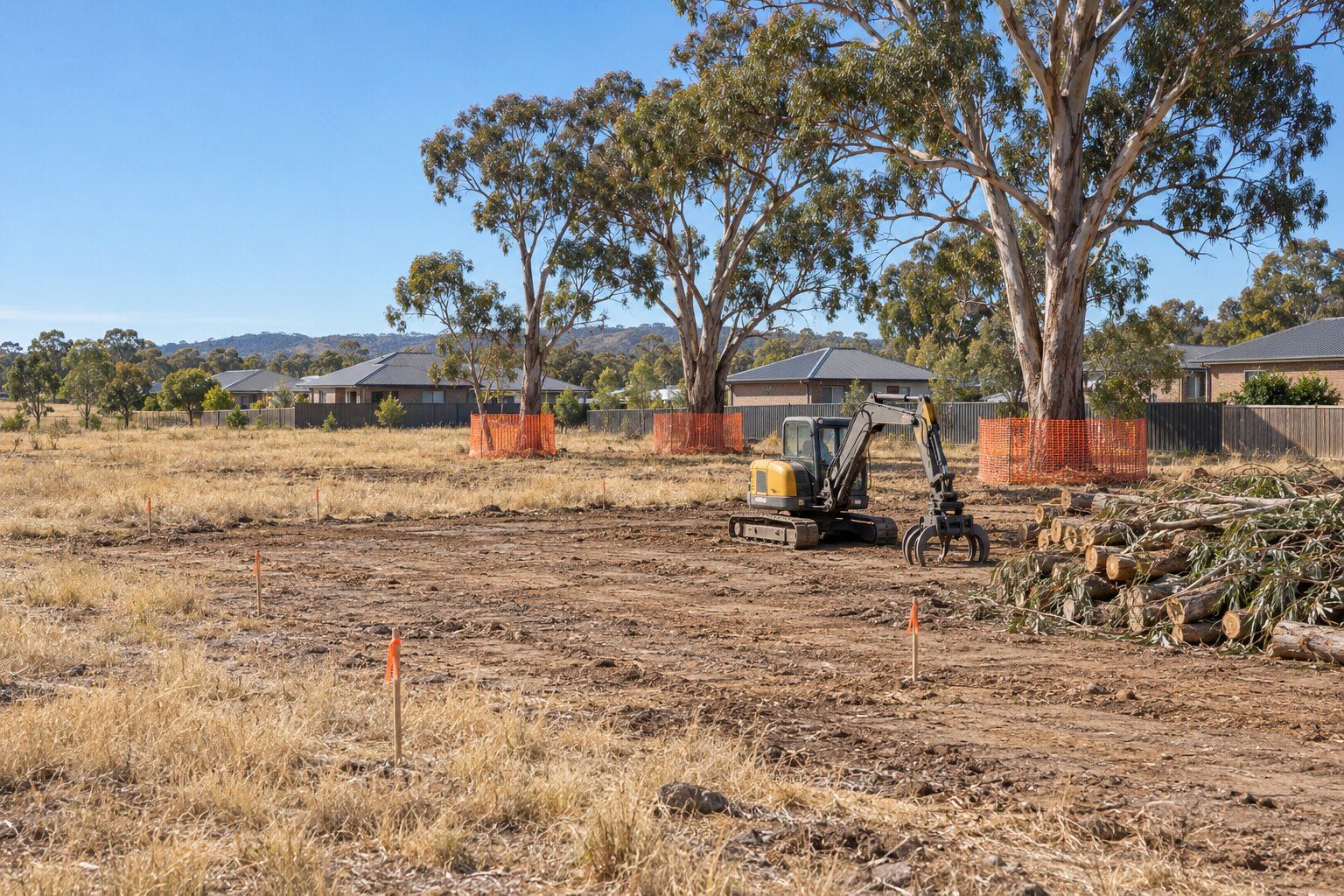
- Trees staying near the house. If a permit or your design keeps a tree, fence it off before machines arrive. Roots extend well past the trunk, and the Australian Standard AS 4970:2025 (protection of trees on development sites) is what an arborist uses to set the protected root zone.
Questions about clearing a block
Do I need a permit to clear my block in Bendigo?
Often. Removing native vegetation needs a permit unless an exemption applies, such as a block (with any adjoining land you own) under 0.4 hectares. On a vacant lot in the residential zones, every tree at least 5 metres tall with a 4-metre canopy needs a permit, native or not. Overlays can add more. Check your VicPlan report and ask council's planning team on 1300 002 642.
Does a building permit let me remove trees for a new house?
Not on its own. Neither the native vegetation rules nor the canopy tree rule has an exemption for a building permit. The exceptions are clearing for a new dwelling's defendable space inside the Bushfire Management Overlay, within the limits the planning scheme sets, and a limited exemption for a dwelling in the Farming or Rural Activity zones.
How much does it cost to clear a block of land?
No Bendigo business we found publishes a block clearing price. A national marketplace's guide (updated 28 January 2026) gives $200 to $1,000 for levelled land with minor vegetation, $1,500 to $3,000 for flat land with rocks and vegetation, and $3,500 to $6,750 for hilly land with lots of trees, without stating a unit or what's included. Two Bendigo plant hire businesses publish $110 an hour plus GST (Sandbox) and $110 an hour including GST (Apollo) for a mini excavator with an operator.
What's the fine for clearing native vegetation without a permit?
Council can issue a planning infringement notice of 5 penalty units for an individual or 10 for a company ($1,045.50 or $2,091 at the 2026–27 rate, by our arithmetic), and court penalties go much higher. In November 2023 a Junortoun landowner was fined $20,000 without conviction, plus council's legal costs, for removing native trees without a permit.
Can I burn the trees I clear?
Not green vegetation: the City of Greater Bendigo bans burning green garden waste year round. A dry pile of wood can be burnt outside the Fire Danger Period with a council permit on blocks under a hectare, after notifying fire services and neighbours. Most people chip the branches on site and take or split the logs.
Can trees stay inside the 30 metres of defendable space?
Yes, if they're managed. Greater Bendigo's bushfire overlay schedules ask for tree canopies separated by at least 2 metres around a new single dwelling, and the defendable space standard they apply (Clause 53.02) also requires no shrubs under trees, branches at least 2 metres off the ground and nothing overhanging the house.
Where this information comes from
The rules and figures on this page come from these published pages, checked on 23 October 2026.
- VicPlan · Victorian Government map for planning property reports (zones and overlays)
- Greater Bendigo Planning Scheme, Clause 52.17 Native vegetation · State-wide native vegetation provision and its table of exemptions
- Greater Bendigo Planning Scheme, Clause 52.37 Canopy trees · State-wide canopy tree provision for residential zones, its definitions and table of exemptions (amended VC315, 24 September 2026); checked 22 October 2026
- Greater Bendigo Planning Scheme, Clause 32.08 General Residential Zone · When one dwelling needs a planning permit (a lot under 300 square metres), 31/03/2025 VC267; the Neighbourhood Residential and Township zones say the same; checked 23 October 2026
- Greater Bendigo Planning Scheme, vegetation and heritage overlays (VPO, SLO, ESO, HO) · Overlay clauses and their Greater Bendigo schedules
- Greater Bendigo Planning Scheme, Clause 44.06 Bushfire Management Overlay · When the BMO needs a permit for buildings, works and subdivision
- Greater Bendigo Planning Scheme, Schedules 1 and 2 to Clause 44.06 (BAL-12.5 and BAL-29 areas) · Greater Bendigo's single-dwelling defendable space requirements, 18/12/2020 C245gben; checked 23 October 2026
- Greater Bendigo Planning Scheme, Clause 52.12-5 Bushfire protection exemptions: new dwellings in the BMO · Exemption for clearing to build a dwelling and create its defendable space in the Bushfire Management Overlay (52.12-5, 25/02/2025 VC257); checked 23 October 2026
- Greater Bendigo Planning Scheme, Clause 53.02 Bushfire planning · Defendable space vegetation management requirements (Table 4), clause 53.02-5 dated 05/05/2026 VC248
- Planning and Environment Act 1987 (Vic), Authorised Version No. 167 · Offences (s 126), penalties (s 127) and planning infringement notices (s 130), in force from 3 August 2026
- Victorian Government: value of a penalty unit from 1 July 2026 · Notice under the Monetary Units Act 2004: $209.10 a penalty unit for 2026–27, published 5 May 2026
- Bendigo Advertiser: Bendigo business owner faces massive fine for Junortoun tree removal · Local news report of a native vegetation prosecution, 24 November 2023
- Sandbox Machine Hire: hire with operator · Bendigo plant hire business, mini excavator with operator; checked 23 October 2026
- Apollo Mini Excavator Hire Bendigo: excavator hire · Bendigo plant hire business, mini excavator with operator; checked 23 October 2026
- hipages: how much does land clearing cost · National trades marketplace cost guide, updated 28 January 2026; the same bands appear on Airtasker's guide of 8 November 2023
- City of Greater Bendigo: Eaglehawk Landfill · Council green waste rules and fees
- City of Greater Bendigo: fires, burn-offs and permits · Council rules on burning garden waste
- CFA: fire restriction dates · Fire Danger Period declarations by municipality
- CFA News: fire restrictions announced for the north-west · The 2025–26 Fire Danger Period for Greater Bendigo, from 17 November 2025, published 31 October 2025
- Before You Dig Australia: FAQs · National referral service for underground asset plans; free enquiries online or by app; checked 23 October 2026
- Standards Australia: AS 4970-2025 Protection of trees on development sites · The Australian Standard behind tree protection zones in development reports, store listing