The short answer
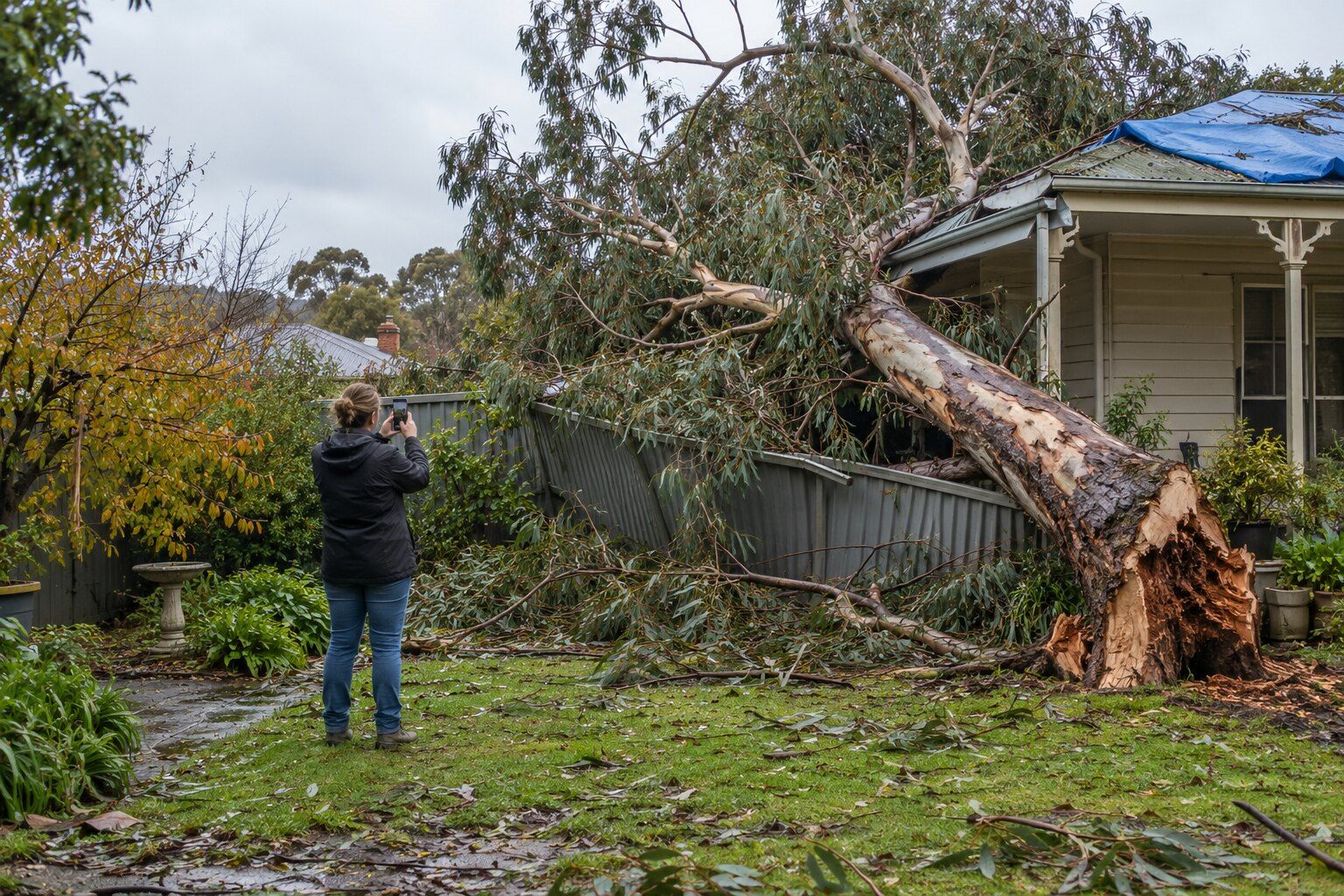
It depends on your policy. The two home building policies we checked pay to remove a fallen tree that damaged the insured building, but not one that fell without damaging anything, and neither pays to remove the stump; Financial Rights Legal Centre says some policies only pay for removal when the tree damaged the home or contents. A healthy tree that falls in a storm is usually treated as nobody's fault, so each owner claims on their own policy; the tree's owner may be liable if they knew, or should have known, it was dangerous. A damaged dividing fence is shared equally by default; if the repair is urgent and you can't practicably give a fencing notice first, you can repair it and ask your neighbour to contribute afterwards. Take photos and talk to your insurer before anything is moved.
First, make it safe
- Anyone in danger: call 000.
- A tree that has caused structural damage to your home or vehicle, or is stopping you getting in or out: call VICSES on 132 500. VICSES says it "may undertake emergency temporary repairs"; for "removal of debris and cutting down of trees that are still standing", it says to contact a professional tradesperson.
- A tree on powerlines, or lines down: keep at least 8–10 metres away and call Powercor on 13 24 12.
Our storm damage and dangerous trees page has the steps in order. Once it's safe, the questions are who pays and what to do before anything is cut.
Need this done?
Does home insurance cover tree removal?
It depends on your policy, and on whether the tree damaged something your policy insures. Financial Rights Legal Centre puts it this way: "Some insurance policies will only cover the cost of removing the tree if it causes damage to the insured home and contents. If there is no damage to the home or contents, then you may have to pay your own removal costs." Read your Product Disclosure Statement (PDS); here is how two insurers word it; yours may differ.
The tree damaged your house
RACV's home buildings PDS says that if a tree on your property damages your home "and a qualified expert agrees it needs to be removed", it pays to "cut down and remove the tree" and "treat the stump so it doesn't grow". AAMI's building PDS pays for "removing debris, including fallen trees or branches" when the debris damaged the building, that damage is covered, and removal is needed to repair the building. That cover, together with making the building safe and other rebuilding costs, is capped at 15% of the building sum insured for any one incident unless you have its Complete Replacement Cover option.
The tree fell and damaged nothing
Both policies exclude it: RACV doesn't cover "costs to cut down or remove a tree if it didn't cause any damage to your home or contents", and AAMI excludes "removing debris, including fallen trees or branches, or lopping trees or branches that haven't damaged the building". A tree across the lawn or the back paddock is usually the owner's cost.
The stump
RACV excludes "costs to remove the stump", and AAMI excludes "the removal of tree stumps or roots still in the ground". If you want the stump ground out, expect to pay for it yourself; see stump grinding cost.
Damage while trees are being cut
Both policies exclude damage from tree lopping or felling that you arrange. Financial Rights notes this is a common liability exclusion and says: "Make sure any contractor doing tree work has insurance cover." Ask whoever cuts the tree for their insurance details before work starts.
Before the tree is cleared: photos and your insurer
- Moneysmart: "Before you move anything, take photos and videos of the original damaged state."
- "Talk to your insurer before you spend money on temporary repairs after an incident." Many insurers can arrange emergency repairs themselves, such as removing loose debris or putting a tarp on the roof.
- Financial Rights says not to throw anything away unless it's a danger, and to get the insurer's permission first.
- You must take reasonable steps to stop further damage, such as a tarp over the roof, and keep photos and receipts of what you did.
- You pay the excess set out in your policy before the insurer pays the balance.
If the insurer agrees to you arranging the tree removal, a written quote that separates making the area safe, removing the tree and the stump makes it easier to see what the policy pays for.
The neighbour's tree fell on my house: who pays?
Victoria has no specific law on neighbours' trees; the courts' common law applies. The Victorian Law Reform Commission explains that "if a tree had shown no signs of decay or structural damage, then its unforeseeable fall during a storm and resultant damaging of neighbouring property will not confer liability on the tree owner", and that "the likely course of action is for the affected neighbour to claim on their own insurance".
It's different if the owner knew, or should have known, the tree was dangerous: a dead, decaying or leaning tree, or one an arborist had said should come out. The Commission says liability begins "when a tree owner gains actual knowledge of the nuisance or when they ought to have known of the nuisance", and that your insurer may then seek to recover from theirs. The same works in reverse: if your tree falls on the neighbour's place, Financial Rights says you're usually not liable if it was healthy, but "if you knew the tree was dangerous, you may be liable".
If you think the neighbour is liable, the Victorian Government suggests an arborist's report showing the tree caused the damage, photos, and quotes for repairs or removal. Try to agree first; the Dispute Settlement Centre of Victoria can help for free, and the Magistrates' Court is the last step.
Who pays to fix a fence damaged by a fallen tree?
Under the Fences Act 1968, neighbours are "liable to contribute in equal proportions" to a sufficient dividing fence. The exception is section 9: an owner is "liable for the entire cost" of repairing a dividing fence damaged "by a negligent or deliberate act" by them or someone on their land with their consent. The Act doesn't mention trees there; the Law Reform Commission's view is that a fence damaged by a tree its owner failed to deal with can fall under it. A healthy tree blown over in a storm usually means equal shares.
Insurers generally pay only their own customer's share: AAMI's PDS says "We'll only pay you for your proportion of the ownership of a shared fence", and both of those policies exclude fences that were already in poor repair.
Urgent fence repairs
You can repair a damaged dividing fence without a fencing notice or the neighbour's agreement if the work needs to be carried out urgently, the fence "has been damaged or destroyed", and "it is impracticable to give a fencing notice" (section 23). The Act's note names "a falling tree or branch" as one such case. The Victorian Government still recommends talking to your neighbour first.
Getting the neighbour to contribute
Afterwards, give your neighbour a written urgent fencing notice (section 24) that sets out the work, why it was urgent, the cost with a copy of the receipt, and the share you're asking them to pay. If you haven't agreed after 30 days, either of you can apply to the Magistrates' Court.
Permits and the cost of storm tree removal
The native vegetation rules and the canopy tree rule both exempt a tree that presents an immediate risk of injury or damage, but only the part that presents the risk. Making it safe is fine; check before removing the rest of a damaged tree. Our permits guide explains both rules.
No Bendigo tree business we found publishes an emergency or after-hours rate, so storm work is priced per job once the area is safe. Our tree removal cost guide has published Bendigo prices by tree size as a guide. Tell us what the tree is resting on, whether your insurer is involved and the access, and we'll price the removal in writing.
Got a tree that's leaning, cracked or dead over the house? Insurers don't pay for prevention, but Financial Rights notes "it is in your interests to address the problem": see is my tree dead or dangerous?
Questions about storm trees and insurance
Does home insurance cover tree removal?
It depends on your policy. Financial Rights Legal Centre says some policies only pay for removal when the tree damaged the home or contents. RACV's PDS, for one, pays to remove a tree on your property that damaged your home, but not one that "didn't cause any damage to your home or contents". Check your own policy's wording, and talk to your insurer before work starts.
Does insurance pay to remove the stump?
Not under the two policies we checked: RACV excludes "costs to remove the stump" (it pays to treat the stump so it doesn't regrow) and AAMI excludes "the removal of tree stumps or roots still in the ground".
My neighbour's tree fell on my house in a storm. Who pays?
Usually you claim on your own insurance. If the tree was healthy, its fall in a storm isn't normally the owner's fault. If the owner knew or should have known it was dangerous, they may be liable, and your insurer may seek to recover from theirs.
Who pays for a fence damaged by a fallen tree in Victoria?
Under the Fences Act 1968, neighbours share the cost of a sufficient dividing fence equally, unless one of them damaged it negligently or deliberately, when they pay all of it. Insurers generally pay only their own customer's share.
Can I fix the fence straight away without my neighbour's agreement?
Yes, if the repair is urgent, the fence has been damaged or destroyed and it's impracticable to give a fencing notice first; the Act's note names a falling tree. Then give your neighbour a written urgent fencing notice with the cost and receipt to ask for their share.
Will the SES remove a fallen tree?
VICSES may do emergency temporary repairs when a tree has damaged your home or blocks access, but for "removal of debris and cutting down of trees that are still standing" it says to contact a professional tradesperson. Call 132 500 for storm help and 000 if anyone is in danger.
Where this information comes from
The rules and figures on this page come from these published pages, checked on 23 October 2026.
- Financial Rights Legal Centre: tree damage in a storm · Community legal centre (national Insurance Law Service) fact sheet, last updated December 2024
- Financial Rights Legal Centre: storm insurance · Community legal centre fact sheet on storm claims, last updated March 2025
- Moneysmart: how to make a home insurance claim · ASIC consumer guidance, last updated 18 August 2026
- RACV Home Insurance Product Disclosure Statement · One insurer's policy wording (PDS prepared 2 August 2022, with supplementary PDSs of 2023), checked 23 October 2026
- AAMI Home Building Insurance Product Disclosure Statement · One insurer's policy wording, prepared 4 October 2024, checked 23 October 2026
- Victorian Government: trees in Victoria · Dispute Settlement Centre of Victoria guidance on neighbours' trees, updated 26 February 2026
- Victorian Law Reform Commission: Neighbourhood Tree Disputes consultation paper, chapter 3 · Victorian law reform body's explanation of the common law on neighbours' trees (consultation paper, report tabled 2019)
- Dispute Settlement Centre of Victoria · Victorian Government's free dispute resolution service, including neighbours' trees and fences
- Fences Act 1968 (Vic) · Equal shares (s 7), damage by an owner (s 9) and urgent fencing works (ss 23–26), version in force from 29 March 2021
- Victorian Government: fencing in Victoria · Dispute Settlement Centre of Victoria guidance on dividing fences and urgent repairs, updated 26 February 2026
- VICSES: what we do · Victoria State Emergency Service on when to call 132 500 and what it does after storms
- Energy Safe Victoria: trees and vegetation · State electrical safety regulator, service lines and fallen powerlines; reviewed 16 March 2026
- CitiPower and Powercor: vegetation management · The electricity distributor for Bendigo, on trees near powerlines
- Greater Bendigo Planning Scheme, Clause 52.17 Native vegetation · State-wide native vegetation provision and its table of exemptions
- Greater Bendigo Planning Scheme, Clause 52.37 Canopy trees · State-wide canopy tree provision for residential zones, its definitions and table of exemptions (amended VC315, 24 September 2026); checked 22 October 2026